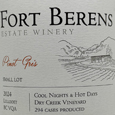
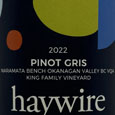
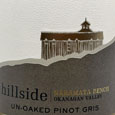
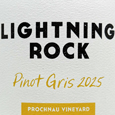
quicksearch


British Columbia pinot gris has become a legitimate shape-shifter in the local market, and one need only explore a glass to experience the changes.
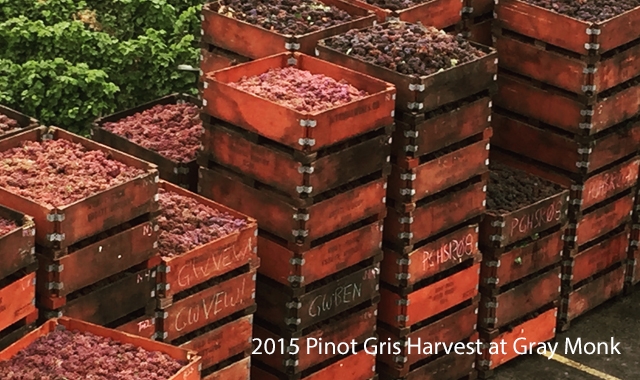
It is one of the foundational grapes of modern British Columbia wine. Its story begins at Gray Monk Estate Winery in Lake Country/Okanagan Centre, where George and Trudy Heiss planted Canada's first pinot gris vines in 1976, after importing Alsace rootstock and working within the broader vinifera experimentation that became associated with the Becker Project.
From a tiny pioneering block of 50 vines, it spread through the Okanagan and later across coastal and interior regions, becoming BC's leading white grape by acreage for much of the modern era. In 2005, vines in the ground covered 453 acres; by 2022, the total had reached 1,306 acres, making it the largest acreage among all white grapes planted.
Commercially, pinot gris worked because it ripened early, sold readily, and gave wineries a reliable early release white. Symbolically, it helped shift BC from hybrid/bulk wine production toward 100% BC grown, quality focused vinifera wines under BC VQA. Its style has also matured: what began as a simple, often slightly sweet, early-market white has increasingly moved toward drier, more textured, and more site-expressive wines, including stainless teel, lees influenced, skin contact, concrete, and coastal saline styles.
In the Okanagan, pinot gris vacillates between ripeness and restraint. Warm sites from Oliver to Osoyoos push the grape towards peach, melon and honeyed notes, often with a round, almost plush mid-palate. Move north or climb into the benches of Naramata or Summerland, and the tone shifts: pear, apple skin, citrus and a subtle desert scrub note begin to define a more interesting wine. The very best examples are no longer about fruit alone. They carry a mineral, wet stone undercurrent and just enough tactile firmness to transform their DNA into something far more interesting.
On the coast, particularly in the Cowichan Valley, pinot gris is telling a different story centred on tension and salinity. The fruit is brighter, with green apple and citrus, and the wines finish with a freshness that practically demands seafood. It's a story of nuance over popularity.
The shift is hardly rocket science, but a more deliberate decision by some winemakers to pick earlier, lean into acidity, and experiment with texture, namely increased lees work, partial skin contact, and even the occasional concrete ferment. The result is a new generation of gris that is tighter, more linear, and focused on precision, with more structured, almost savoury versions. That makes them far more interesting food wines, beginning to win over restaurant buyers and thus increasing their image among consumers as a quality choice.
Think about it. Few people notice a wine when they are sipping it at a party or a busy stand up affair. Still, when a wine bottle sits on the table for 30 or 40 minutes in front of you and is served with food, it usually gets better label recognition over time and is more likely to be recalled when you are shopping. BC pinot gris is finally reaching that level of recognition.
For many white wine drinkers, pinot gris remains a safe, approachable pick, often chosen without much thought. In some ways, that's both its strength and its limitation. Pinot Gris may never be the most glamorous wine in the cellar, but in BC it has become one of the most reliable, and increasingly affordable, buys.
Interestingly, some Italian and French pinot grigio/gris labels have become more popular in BC thanks to curious local consumers who have grown up tasting many local examples from across the province and are now experimenting with international examples. I guess turnabout is fair play.
What follows are the latest results from the Wine Align National Wine Awards along with a list of some of the most promising pinot gris we have tasted at Gismondi on Wine over the past year or two.