quicksearch



Milk type: Cow, Goat and Sheep The word Tomme, as it is usually spelled in France, is a funny one.
Milk type: Cow, Goat and Sheep
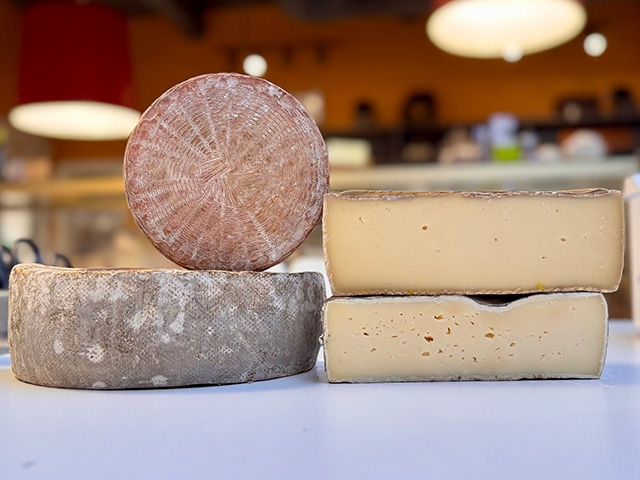
The word Tomme, as it is usually spelled in France, is a funny one. In Savoie, you will see grey moulded wheels; in the Pyrenees, you might see wheels made with goat or sheep milk; and in Bordeaux, you'll find a small wheel brushed with walnut liqueur.
The word Tomme is an ancient French word that translates to a small wheel of cheese. That definition isn't very helpful, since most cheeses are made in a wheel. Just within France, I'm sure there are dozens of cheeses called Tomme, and that's not considering other countries. In Italy there are also Tommes and Tomas. Hmm, cheese lingo, like wine language, can be confusing.
Back to the cheese. The most famous cheese called Tomme is probably Tomme de Savoie. These are smallish, one-and-a-half-kilo wheels with a natural moulded rind. The rind tends to be thick and rustic-looking, and the inside, like many Tommes, has an open texture dotted with small eyes. The paste is semi-firm, with a generous amount of creaminess. The flavour is slightly fruity, but with a good amount of earthiness, a bit like a cellar, on the finish. Sadly, it's been almost a year since we have had any true AOP Tomme de Savoie in Canada because a cattle virus cropped up last fall in eastern France and Switzerland.
Luckily for us, lots of other delicious Tommes can satisfy our cravings for this tasty cheese.
I love this style of cheese, and one of my favourites is Tomme de Montagne. Many makers in the Savoie or Auvergne regions make this, and it resembles Tomme de Savoie but is usually made in larger wheels with a slightly finer crust and fewer eyes. The taste is similar, though not the same, but it is closer than most.
I also really like Toma Piemontese. This Italian Toma is a little fruitier and lighter-tasting, with a similar semi-firm texture and a paste dotted with small holes (or eyes). I love this one because it pairs so well with wine. The flavour is a bit milky, with a slightly lactic tang and a lovely velvety mouthfeel. It seems to complement red and white wines equally.
We also stock quite a few goat tommes. Tomme de Chèvre Onetik, made by a famous Basque producer in the Pyrenees, is a delicately flavoured Tomme, and Tomme Haut Richelieu is a great full-flavoured goat cheese from Quebec, made by Fritz Kaiser.
These cheeses tend to have a fairly subtle flavour, so you don't need much to pair with them. A nice baguette or a ripe pear works well. It always seems to me like the perfect cheese to trim a chunk and eat as a snack on its own. By the way, many of these cheeses have a crust that isn't really meant to be eaten. It is part of the ripening process and what gives the cheeses their great flavours, but it doesn't necessarily add to the eating experience. None of the rinds will hurt you, but a good rule of thumb for most of these cheeses is to take the rind off before eating.
If you go to a food market in France, you are sure to see wide varieties of Tomme, or Tome as it is often spelled, but both are pronounced "tom," not "tommy" as our English-speaking brains want to say.
Next time you see one on your travels, whether in the French countryside or your local cheese shop, try one of my favourite styles and let me know what you think.