quicksearch


Allison is away on holiday this month, no doubt pursuing her cheese dreams.
In her absence, we have gone back to a very useful early article she wrote for us on how to store cheese. ED
When we have done group cheese tastings in the past, one of the questions that comes up the most often is how to preserve and care for cheese.
That is an excellent question because cheese is pricey, and it's a shame to waste it by not protecting it. I always think of everyone who worked hard to make the cheeses we enjoy. I think of the farmer who cared for and milked the animals, the cheesemaker who made and aged the cheese, and everyone who cared for it on the long journey to the West Coast. I want to respect their work by caring for the cheese they produce as carefully as possible, and I want everyone else to have the same tools to make their cheese last as long as possible so that none is wasted.
First, cheese needs to be stored in the fridge. I think we have the idea that they don't keep cheese in the refrigerator in Europe and that leaving it on the counter for days is okay. That just isn't so.
In winter, our houses are heated, and in summer, they probably aren't air-conditioned, so the temperature is not only warm but fluctuates a lot throughout the day. Just like wine, cheese doesn't like temperature swings. Leaving cheese out of the fridge for more than four or five hours isn't good. It will just spoil faster.
Leave your cheeses in the fridge for a couple of hours before serving. I usually leave soft cheeses out for 2 – 3 hours and hard cheeses out for about an hour. If you leave firm cheeses out too long, they get sweaty on the cut surface.
There is a debate over whether plastic wrap or paper is better for cheese. They are both equally excellent and imperfect.
If you buy a piece of cheese wrapped in plastic, it should last a few weeks that way. Once you unwrap it, you must wrap it in a brand-new cling film or plastic wrap, or else the cheese will no longer be protected. This style of wrap doesn't reseal once you've opened it, so if you put it back in the same piece and bundle it in your fridge, it will dry out quickly. Ideally, get a fresh wrap and rewrap it every time you open the cheese. If you do, a few weeks in your fridge is realistic. If you rewrap it in the same piece it came in, the cheese will probably start getting dry before the end of the week.
Cheese paper has a few great points and drawbacks. For people trying to cut down on plastic, many (though not all) cheese paper brands are biodegradable or compostable. Some of them are even reusable.
Now for the wrapping. If the piece is wrapped well, it should last as long as cheese wrapped in plastic. However, some people like wrapping presents better than others. If the piece isn't wrapped tightly, with the edges tucked in, you may end up with a piece of cheese that dries out quickly in your fridge.
To combat that, or your not-resealed plastic wrap, you could keep your wrapped cheese in a glass or plastic container with a tight-fitting lid. One more layer of protection won't hurt.
I always try to balance the cost of the plastic or paper with the cheese price. People say they don't want to waste plastic by wrapping a piece up in new cling film when it's already in a piece. Although I understand the sentiment, how much did that 10-inch piece of plastic wrap cost compared to the cheese you're trying to preserve? I'm guessing the cheese cost a lot more.
The only thing that I don't like about preserving cheese is vacuum-sealed packaging. Even though you have sucked all the air out of the packaging, the cheese is still aging. You haven't stopped that process. It's also tricky to not crush the cheese while removing the air from the packaging. If your cheese has small eyes throughout, it will likely look like a smooth paste when you take it out of a vacuum-sealed bag.
Vacuum sealing is especially bad for soft and washed-rind cheeses. It's better to keep it in your fridge in paper or plastic wrap; buying more frequently is the best option.
We recently experimented with the store. We saw a post a company made showing how much better their cheese paper kept cheese than saran wrap/cling film. The post showed a picture of two pieces of cheese, one in plastic and one in cheese paper. They claimed the cheeses had been wrapped for two weeks, and I thought the picture they showed was skewed in their favour. It seemed they hadn't used two equally fresh pieces of cheese when they started the two weeks.
It prompted me to test how cheese would fare if we cut fresh pieces and how long they would last nicely in the fridge.
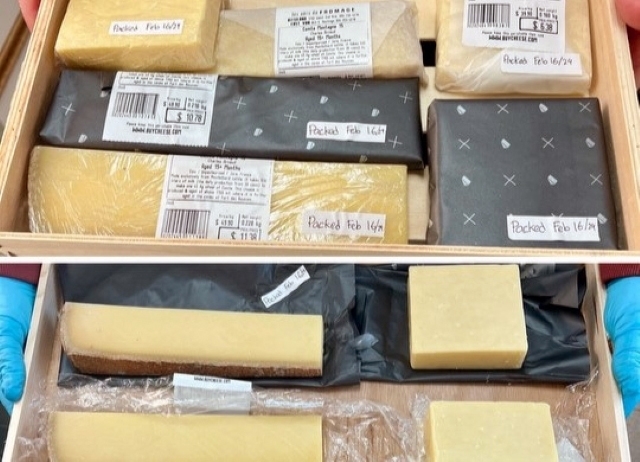
We used three freshly cut pieces of Comté and three pieces of Cheddar for our experiment. We wrapped one in reusable cheese paper, one in cling film and one in slightly waxed scale paper sheets.
We put them in our fridge and left them for nineteen days.
Both the cling film and the cheese paper looked pretty much identical. The pieces we had wrapped in scale paper were somewhat dried out. Perhaps if we had kept them in a plastic or glass container, they would have lasted longer, but we treated all six pieces the same. The picture accompanying this article shows our results. It shows that whichever covering you prefer is fine, as long as you wrap the cheese carefully.
Another enemy of cheese is the freezer. My rule of thumb is that if you cook with it, it's fine to keep it in the freezer for a month or two, but if you are going to serve it on a cheese board, don't freeze it.
Freezing tends to remove moisture from cheese. If you freeze soft cheese with a higher moisture content than firm cheese, you will end up with a crumbly, slightly soggy cheese—nothing that you would be happy to serve or eat yourself. If you have a few chunks of Cheddar or some grated Reggiano around and you're worried about them getting mouldy, popping them in your freezer for a future mac n cheese recipe is just fine.
I'm always sad to see cheese thrown away, so I hope this information helps you enjoy your cheese and keep it longer.