quicksearch


Wine writing and education usually center on information: they cover grape varieties, aroma profiles, production techniques, and the like.
Communication to professional and lay audiences differs by technical nuance but not by its overall thrust.
This undercuts wine’s communicative power. People do not drink wine to smell yellow apple; they drink to experience joy and pleasure: sensory, emotional, and intellectual. Wine education needs to cater to these emotional needs. Especially so in British Columbia. As a relatively new region in the world of wine, BC cannot compete on cost (too expensive), international reputation (too little of it), or hospitality infrastructure (same). To compete on quality, BC wine needs to be framed by compelling stories about nature, history, and place: stories that engage our emotion and our capacity for pleasure.
This is well understood by wine professionals and enthusiasts. The gap lies in translating that understanding to actual education and communication efforts in the province. There is a lack of faith in the curiosity and perceptiveness of the wine-drinking public. I thus argue for wine communication that is more confidently place-based. Drawing on my research and teaching at UBC-Vancouver as well as the broader societal discussion on the future of wine in social life, I foreground communicative possibilities beyond tasting notes or lifestyle marketing.
Product and brand
Wine education in North America is closely linked to commercial branding. Without a multi-generational wine culture in society at large, many producers strive to make their product easy as a consumer product. Such a product’s connection to place is tenuous. When a blurb about nature or history is devised, its role is often to sell the air of distinction. The consumer is treated as a passive object of sales technique.
As wine consumption per person has declined, that assumption of passivity has become more entrenched: the stress on experiences in marketing strategies is largely a stress on entertainment. As the middle class erodes and young people in particular struggle financially, cheap fun seems necessary.
In parallel, there is a growing cross-generational interest in ecotourism and enotourism as pathways to a more authentic way of living. There is also a renewed quest for reclaiming the pleasures of sociability—which center on the pleasures of the table—in human life. The wines that engage with that quest sell at a higher price point. To create the market for such wines, communication strategies need to be grounded in the complexity of place: in linking wine to the taste of the living world. That phrase is a quote from Pascaline Lepeltier, a New York-based sommelier and educator. One does not need to follow Lepeltier on everything to be persuaded by her faith in authentic and communicative wines of emotion. She writes: ‘Wine is one of mankind’s most beautiful creations. [...] it invites us to marvel anew at ourselves and all that surrounds us. Behind all the codes and rules, the prejudices and systems created to perform and control, there lurks the imperfect beauty, so diverse and unexplored, of human liberty and the vitality of life that, ultimately, are one and the same’.[1]
The contrast between Lepeltier’s voice and that of a typical marketer is striking. Lepeltier assumes the wine-drinker’s freedom, curiosity, and capacity to engage. She goes straight to the core of why wine matters: to the voluptuous bundle of beauty, pleasure, and vitality that draws us to wine. I see some such bundle in my classes at UBC. The students who engage with wine speak of family meals and trips, of exploring places and histories, of sociability and conviviality. They speak of enjoyment more than fun. For them, wine writing needs to evoke as well as inform.
Large-scale branding has its place, for artisanal product is only one among many on a crowded marketplace. As the market segments, even bifurcates, so do communication strategies. Volume wine is increasingly standardized to compete with cocktails and it is increasingly designed by technological means, regardless of what the marketers say. The artisanal product is meanwhile moving closer to place and engaging more with organic and biodynamic viticulture as well as local food—and with those wine-drinkers for whom the taste of place is the draw.
Place and pleasure
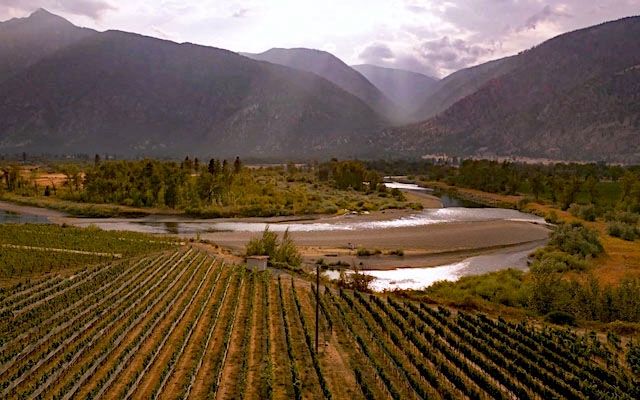
The importance of storytelling is certainly recognized in BC. Today, it is operationalized at the level of individual businesses rather than regions. Communication strategies are too often trapped in a vicious cycle in which the putative lack of wine history and culture limits the stories that can be told about the place. A more coherent strategy requires a collective effort to tell the regional stories that frame the stories of individual producers. That effort does not start with product reviews; it starts with place-driven narratives that amount to more than clusters of product links.
Educators and writers play a part in creating the imaginaries that frame BC wine in the public sphere. Whether British Columbia ‘has’ the history or the culture is not the central issue: all histories and cultures, in all places, are created through collective human effort. Famous wine regions also created their stories: they just did it earlier than BC. Not telling a collective story also tells a story, and it is one of a region that has not yet developed its own story.
Wine communication in British Columbia needs to broaden not only from product to experience but also from product to place. Through a more deliberate and evocative storytelling about place, it can better respond to the growing interest in authentic food, wine, and connectivity in many parts of the society. Wine education and wine writing can thereby enrich both our appreciation of wine and our relationship to nature, farming, and sociability.
[1] Pascaline Lepeltier (2024) One Thousand Vines: A New Way to Understand Wine, Mitchell Beazley, p. 11 (both quotes).