quicksearch


Pinot noir plays the edges.
Its flavours and subtle expressions of terroir are most articulate and profound only in a few very particular places on earth. It demands just the right amount of virtually everything that influences a vineyard's situation. When enough of those elements are right, it can produce wines that are superb, even thrilling, fetch higher prices, and contribute solidly to a winery's reputation, bottom line, and continuation.
So, how do these tucked-away special Pinot Noir plots get found in the first place? Ultimately, it's still guesswork, and it takes about seven years for the planted vines to mature and for you to know whether the guesswork was successful. It's a long cycle of speculation and discovery. In places like the Côte d'Or of Burgundy, where every rise, dip and curve of the pinot noir vineyards has been classified and ranked, It's the result of 800 vintages of history and experimentation.
In the New World, modern technologies, tools, and methodologies enable detailed analysis of vineyard sites, shortening the overall time frame, even if the seven-year cycle is impossible to compress. But it's still guesswork, even if it is highly informed. A founder's site research must conclude that something is exceptional about the area and that a particular, unfledged piece of ground warrants the risk and the decision, both faithful and fateful, to plant a vineyard. Additionally, if the proposed site is to be the home vineyard that anchors a winery, other supporting and enabling commercial and practical considerations must also be favourable, such as accessibility, proximity to the winery, land cost and zoning, water rights/irrigation access, location in a recognized appellation (in B.C., a GI or sub-GI). It's a lot.
Oregon and New Zealand both have well-established, well-deserved reputations for their pinot noirs. The modern wine era in Oregon got rolling in the mid-sixties and in New Zealand about ten years later.
The B.C. wine industry is relatively much younger. With a first pinot noir released in 1989, Quails' Gate Winery is the first pinot noir producer of the vinifera era in British Columbia. The modern B.C. wine industry only began properly in the early nineties.
Pinot noir is found in all of British Columbia's wine regions. It is now the most widely planted red grape in the province. The modern era of vineyard location research in B.C. for this grape and others is very short, only about 35 years or five of those seven-year cycles. Not surprisingly, results have ranged across the spectrum. On the fortunate side, remarkable pinot noir reds from distinct single vineyards, as well as unique sections of those vineyards, are emerging in many of the GIs and sub-GIs, including but not limited to Kelowna, Okanagan Falls, the Cowichan Valley, and the Naramata Bench.
At the other end of the B.C. pinot noir experiment, some of the results have not been so sunny. Naturally, there have been wrong guesses, miscalculated factors and overly optimistic hopes. In places, pinot noir did not thrive, ripen optimally or show its best. It behaved indifferently or sullenly, and produced simple, unremarkable red wine. Additionally, the commercial and practical demands of running a winery can bring misfortune, regardless of the wines' success.
B.C.'s Vancouver Island GI exemplifies the variety of the challenges and opportunities that winery owners, vineyard managers and winemakers must face when growing pinot noir as well as succeeding overall.
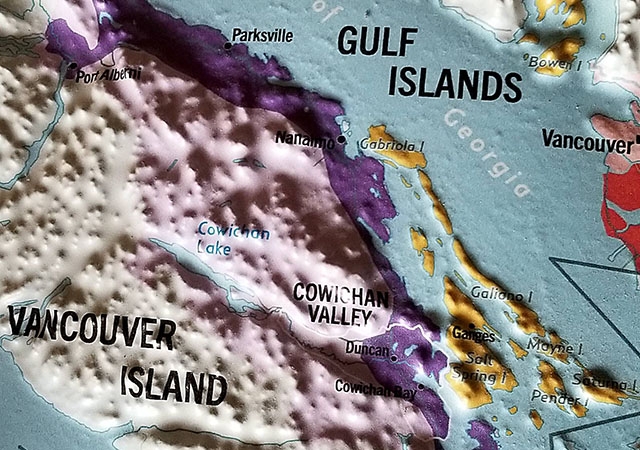
Vancouver Island is a little bigger than Sicily, half-tucked into a Pacific Northwest pocket on the west side of North America. It sits amongst the active boundaries of three tectonic plates – the North American, Pacific and Juan de Fuca- and the Cascadia subduction zone. Its geological history includes volcanoes, mountain folding, earthquakes, tsunamis and other tectonic events. Add in periods of ocean submersion and resulting marine sediments, glaciers, and morainal deposits, and the extensive diversity of soil types, slopes, altitudes and prospects in the area's geography is no mystery.
This year's Summerland fires showed again that nature doesn't always cooperate. It's still farming, and farming requires patience. Following the catastrophic winter freezes of 2023 and 2024, many wineries are for sale, and a few didn't make it.
Wineries, like other businesses, rise and fall, but unlike a restaurant or a store, where the space can be taken over by the same type of business or be repurposed, wineries and especially vineyards are a different case. When a winery closes, I always wonder what happens to the estate vineyards. A vineyard can persist for a while on its own, untended, though it ultimately needs maintenance. Some will continue to be farmed by others for wine grapes, and some will fail or be converted to other uses. These are the lost vineyards.
Pinot noir's island outposts have seen their own ups and downs. The grape has been tried in some surprising locations. It's worth looking back over the last twenty years or so to some of the more marginal areas for pinot noir on the Pacific coast in the Vancouver Island GI to see where natural forces and the fates aligned to produce success. It's also important to acknowledge the folks at some of those pioneering wineries who often gave a decade or more of their time and effort, even if they eventually came up short. Here is a selection from the past and present of the fortunate, the failed, the marginals and the movers who made pinot noir wines on Vancouver Island. They are an important part of B.C. wine's story.
40 Knots Winery is Vancouver Island's most northern pinot noir outpost. Founded by Bill Montgomery and first opened in 2011, the winery is a very scenic 225 km drive from Victoria. Pinot noir comprises about a quarter of the acreage. From the outset, the 40 Knots pinot noir showed well. Layne Robert Craig and his wife, Brenda Hetman-Craig, purchased the winery in July 2014.
The winery is an outpost in terms of latitude and location. Still, it is very much part of the Comox community (pop. 14,000) and is immediately adjacent to Courtenay (pop. 28,000). This proximity to population has enabled 40 Knots to connect with the Comox Valley community and become a successful destination through its extensive programming of events, classes, and seminars.
The Vancouver Island Range is one of the protective necklaces of mountains that run along the centre of Vancouver Island, creating an elevated barrier between the East and West coasts. One of the few connecting passages is Highway 4 through Alberni Inlet, a remarkable geographical feature that starts on the island's West coast and thrusts 35 kilometres eastward, nearly dividing Vancouver Island in two. Two pinot noir wineries were established along this route.
Evan McLellan founded the Emerald Coast winery, which opened in 2009. Emerald Coast was the only winery on the main road to the island's popular West Coast tourist areas of Tofino and Ucluelet. Two of British Columbia's wine industry pioneers, Claude Violet and John Harper, helped him choose and source pinot noir clones that would thrive in the more continental climate in the area. It closed its doors in 2022 when the owners eventually decided to retire and move on to other ventures.
A second winery, Chase and Warren, was a 4-hectare vineyard planted in 1996, started by Vaughan Chase and located just north of Port Alberni in a scenic but less travelled area. Even though it was a stop on local heritage steam train tours of the Esquimalt and Nanaimo Railway (E&N Railway), it closed in 2017.
Further south, Nanaimo is the second-largest city on Vancouver Island, an important ferry terminal connecting to Vancouver, and home to several wineries.
Chateau Wolff has some of the oldest pinot noir vines on Vancouver Island (planted in 1990) and was begun by hotelier Harry von Wolff. Wolff passed away in 2005, and the five-acre vineyard did not produce wine grapes for almost a decade, though his heirs and friends loyally pruned and maintained it in memory of his dream. Matt and Natalie Riga purchased the property in 2014. They kept the winery's name to preserve his legacy. They operated it for a decade before closing in March 2024. Emandare Vineyard in the Cowichan Valley now manages the vines and makes wines using grapes from the Wolff estate, so Harry's vision lives on.
Dale Shortt started Millstone Estate Winery, with its 6-acre vineyard in a warm microclimate pocket adjacent to Nanaimo, in 2001 and opened its doors in 2009. The intention was for the winery to become an ongoing family business, but it never truly found its feet, and the winery closed in 2021.
When prospecting for suitable vineyard sites, there's trial and error but also trial and great discovery. Sitting in the southeast corner of Vancouver Island, not far from the Salish Sea and centred on the 48th parallel, one degree south of the Canada/U.S. border lies the Cowichan Valley. The climate is maritime Mediterranean and sits in the rain shadow of the Vancouver Island Range. Though decidedly cool, the Cowichan Valley has one of Canada's highest average temperatures.
The Valley is by far the brightest spot for pinot noir on Vancouver Island and one of the province's most important areas for the grape. Wineries such as Alderlea, Averill Creek, Blue Grouse, Emandare, Unsworth and Venturi Schulze are making expressive pinot noirs that show the outstanding character of this unique terroir. Some of the first pinot noir vines were planted here in and around 1990. For a wine industry that is only thirty years old, having the right grapes in the right vineyard sites is crucial. Fortunately, many of the pioneering wineries guessed right when they planted pinot noir in the Cowichan Valley. Pinot noir vineyard acreage there continues to grow. The wines have a growing reputation for excellence.