quicksearch


The art critic Walter Pater said, "All art constantly aspires to the condition of music." It might be said that all wine aspires to the condition of pinot noir.
Pinot noir passes through the world of wine like a quiet, respected but unknowable poet. Poets are sensitive and vulnerable but also prodigiously observant of events, feelings, relationships, hardships and beauty as they move through life. Then they take these experiences and, by their nature, employ creativity's oracular process to conjure a poem from them that can be experienced, shared, and understood by others. They may speak quietly but profoundly.
Its thin-skinned nature makes it easily distracted or assailable by disease, mildew or weather events. In addition, its particularity means that, to begin with, it requires the right soil, slope, weather, pruning, clone, maintenance, and more; yet, surprisingly, it's at its most creative, living climatically at the edge.
It needs its sunshine but eschews hot, easy climates unless balanced by cooling wind or fog. Without those factors, it will not produce filigreed, focused, layered fruits and aromatics. It will produce cordial. In fact, it prefers cooler, even harsher climates parenthesized by warm days and cool nights. But in the right places, the grape can rise above variety to express something primal, ancient, and entrancing.
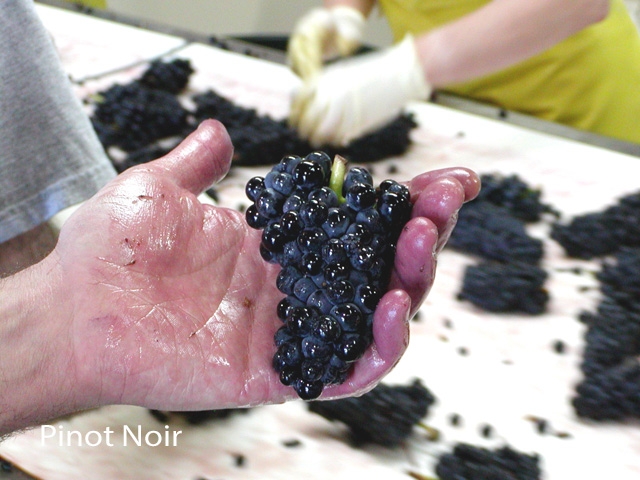
Pinot noir has numerous talents, many of them inexplicable, but the greatest one evident is its thin skin. Thin skins open the window to the intricacies of fruit aromas, and flavours pulled up from the soil through the roots without the shroud of astringent tannins usually present in other red grapes. Its structure is based on acid, not tannins.
Sidonie-Gabrielle Colette, the French novelist and sensual chronicler of gardens, food, desire, and the natural world, wrote that "The grapevine makes the savour of the earth intelligible to man," and pinot noir may be the most eloquent proof of that.
Even with these background elements in place, its fine-tempered fussiness continues with those who coax and shepherd it from grapes to wine. The right green manicure in the vineyard, gentle treatment in the harvest, as well as care, patience, respect, and skill in the vinification, need to be right for that vineyard, those grapes, and that vintage. Pinot noir seems to notice everything and remember everything that happened in the year of its creation. The grape can give articulate testament to the character of the site and soil it grows on. But if for some reason an item is lacking, the imprint will be on the resulting wine and instead of speaking eloquently, it may simply mumble some faint praise of the land or winemaker. Silence is its censure.
Pinot noir has no origin story. It is an ancient variety whose starting point is unknown, but its influence is timeless. It lives on, coded into the nature of its endless progeny to continue to make enthralling wines for us now. It has been known via a whirl of exotic aliases and disguises including: Black Pinot, Pinot Noirien, Pinot St. George, Blauer Burgunder, Pinot de Pernand, Négrette, Beba, Franc Pineau, Noirien, Salvagnin, Morillon, Auvernat, Plant Doré, Spätburgunder, Pinot Nero, Nagyburgundi and many more.
Pinot noir is a mighty progenitor, having at least a thousand known clones and has begat clonal cousins such as pinot meunier, pinot blanc, and pinot gris. In fact, it's "genetically fluid", so close to being a white grape that commonly enough, pinot blanc or pinot gris grapes make guest appearances in pinot noir grape clusters. This aspect of pinot noir also means that it flexes easily to produce other wine styles including sparkling, white, and rosé.
Pinot noir's intrigue includes numerous "suitcase clone" stories of it being kidnapped from Grand Cru Burgundy vineyards and smuggled to far-flung vineyards. It is pinot noir alone that binds disparate wine drinkers (including me) together who have had the epiphany bottle, the magical one that leaves you chasing the pinot noir unicorn forever after.
Adding to the mystery, there are just a handful of magical terroirs scattered around the world where it thrives and is capable of great eloquence.
Trying to convey the attributes of great pinot noir is difficult and often leads to an embarrassing gush of fawning praise, but as I am fully enraptured by it - here goes.
First, there is the startling disconnect between the sometimes very light, sometimes rosé lightness seen in the glass and a nose that holds such elaborate, complex, and overlapping aromas. When you compare it to the intense phalanx of a syrah, merlot, or cabernet, you can't help but ask, "Where is that coming from?" When pinot noir is moved to say something poetic, the flavours can be silky, ethereal, velvety, lacy, delicate, distinctive, woodsy, gamey, herbal, mineral and involve all manner of red and black fruits. Descriptors such as "focused", "precise", "aerial", "soprano", "cross currents", "plush", "spectral", "echoing finish" and hundreds of others spring to mind. It is almost impossible not to anthropomorphize it; at times, you feel you are encountering a personality. Its waves of flavour can seem ironic, its utterances mystical. No other grape stirs such layered thought and feeling as pinot noir.
It lives amongst us an old poet, speaking in tongues.